
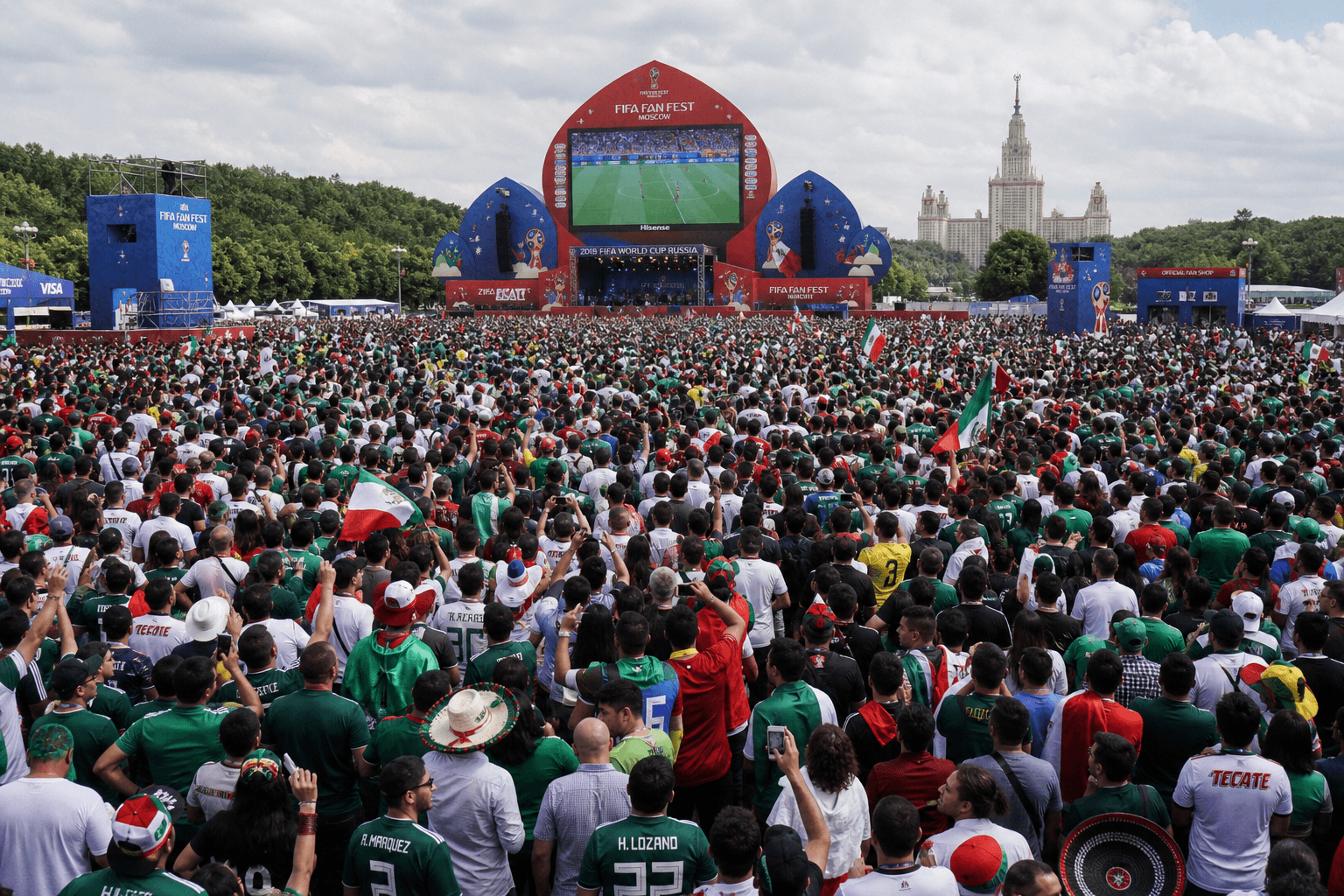
If you want to experience the football fever live, the official Fan Zones World Cup 2026 festivals are the perfect place to watch every match without a ticket.
You don’t need a match ticket to have an extraordinary World Cup experience.
Some of the best moments I’ve had at major football tournaments happened nowhere near the stadium. They happened in the squares and parks outside, surrounded by thousands of fans from dozens of countries, watching the same match on a massive screen, experiencing the same highs and lows at the same moment, with none of the logistical stress of actually getting inside.
Fan zones are not a consolation prize for people who couldn’t get tickets. They are a genuinely different, and in some ways better, way to experience a World Cup.
Here’s everything you need to know about the official fan zones for World Cup 2026 — and how to find the unofficial ones that are often even better.
Make sure to check the nearest Fan Zones World Cup 2026 venue before match day.
What Is a Fan Zone?
A FIFA fan zone — officially called the FIFA Fan Festival — is a free, ticketed (but free) outdoor event space set up in host cities during the tournament. They feature:
Live broadcast of every match on massive screens, food and drink vendors, entertainment and cultural programming, merchandise, and a concentrated gathering of fans from everywhere.
They are safe, organized, and designed specifically for international visitors. Security is present. Facilities are adequate. The atmosphere, on big match days, is extraordinary.
Check the official locations and live opening schedules for all host city fan festivals [Click Here to View Live Status].
Make sure to check the nearest Fan Zones World Cup 2026 venue before match day.
World Cup 2026 Fan Zones — By Country
FIFA typically announces official fan zone locations several months before tournament kickoff. Based on previous World Cup hosting patterns and what’s already been confirmed, here’s what to expect across the three host nations.
🇲🇽 Mexico
Mexico City’s fan zone will almost certainly be centered around one of the city’s great public spaces — historically, Zócalo (the main square) has hosted major public viewing events and is the natural choice for a FIFA Fan Festival given its scale and accessibility.
Guadalajara and Monterrey will each have their own fan zones near or in their city centers. Mexican fan culture produces some of the most vibrant atmosphere of any host country — the fan zones in Mexico will be worth attending even for matches that don’t involve Mexico.
Getting there: All major Mexican host city fan zones will be accessible by metro or bus. Follow the same transport principles as getting to the stadiums — plan early, go by public transit, avoid match day traffic.
🇺🇸 United States
The USA has six host cities: New York/New Jersey, Los Angeles, Dallas, San Francisco Bay Area, Seattle, and Boston. Each will have official fan zone infrastructure, with the largest likely in New York and Los Angeles given their scale and international tourism profiles.
American fan zones will be well-organized, with strong food and beverage options, efficient crowd management, and English-language everything. They will also likely be somewhat more expensive than their Mexican counterparts — this is the USA.
A note on weather: Dallas in June and July can reach 38°C/100°F. The San Francisco Bay Area, counterintuitively, can be cold and foggy even in summer. Check the forecast before heading to your fan zone and dress accordingly.
🇨🇦 Canada
Toronto and Vancouver are Canada’s host cities. Both will have substantial fan zone setups, likely in prominent downtown locations.
Canadian fan zones tend to be extremely well-managed, genuinely inclusive, and very English-friendly. Vancouver’s fan zone, if located near the waterfront as is likely, will be one of the most visually spectacular settings of the entire tournament. The mountain backdrop makes everything better.
Weather note for Vancouver: it can rain in June. Not heavily, typically, but bring a packable jacket.
Make sure to check the nearest Fan Zones World Cup 2026 venue before match day.
The Unofficial Fan Zones: Often Better Than the Official Ones
Here’s something worth knowing that the official tournament guide won’t tell you.
In every World Cup host city, certain bars, restaurants, and public spaces become de facto fan zones through organic gathering rather than official FIFA organization. These unofficial spaces are often where the most authentic atmosphere develops.
In Mexico City, bars and restaurants around Condesa and Roma Norte that show matches become extraordinary social environments on match days. In US cities, sports bars near the stadium areas fill with genuinely mixed international crowds. In Vancouver, any establishment with a screen and enough space becomes a gathering point.
How to find them:
Search “watch World Cup 2026” plus your city on Google the week before you arrive — local media will have covered the best spots. Ask your hotel staff where locals will be watching. Walk toward the sound of a crowd on match day.
The best unofficial fan zone I’ve ever experienced was a square in a city that had no official FIFA infrastructure whatsoever. Just a restaurant that had put up a screen outside, about 400 fans who found each other by instinct, and a match that went to extra time.
No queue. No security check. No merchandise stands. Just football.
Make sure to check the nearest Fan Zones World Cup 2026 venue before match day.
Practical Fan Zone Tips
Arrive early. On major match days — opening match, semifinals, final — fan zones fill significantly before kickoff. For the Mexico City Zócalo or a New York fan zone during a USA match, arriving 90 minutes early is not excessive.
Bring cash. Fan zone food and drink vendors often prefer cash, particularly in Mexico. Have local currency ready.
Check the free ticket situation. FIFA fan zones are free to enter but sometimes require registration for a free ticket, particularly for high-demand matches. Check the FIFA official website in the weeks before the tournament for registration details.
Make sure to check the nearest Fan Zones World Cup 2026 venue before match day.
Know your exit. Large fan zones after an emotionally charged match — particularly one involving the host nation — produce significant crowds. Have your route back to your accommodation planned before you arrive.
Stay connected. Fan zones have WiFi, but it’s often overwhelmed on major match days. Use your Airalo eSIM data rather than relying on public networks.
Make sure to check the nearest Fan Zones World Cup 2026 venue before match day.
If You Can’t Get Into the Stadium or Fan Zone
The honest reality of a 48-team World Cup is that some matches will be oversubscribed at every level — stadium, fan zone, and the better bars and restaurants.
For those moments, hotel rooms with good screens, short-term rental accommodations with living rooms, and private viewing parties organized through local tourism channels all become viable options.
Make sure to check the nearest Fan Zones World Cup 2026 venue before match day.
The World Cup happens across many simultaneous matches, many cities, and many venues. There is always somewhere to watch.
Make sure to check the nearest Fan Zones World Cup 2026 venue before match day.
The Bottom Line
A match ticket for World Cup 2026 is extraordinary. But the tournament exists beyond the stadium gates, across the fan zones and the bar screens and the public squares and the hotel lobbies showing the match in the corner.
The fans who have the best World Cup experiences are rarely the ones with the most expensive access. They’re the ones who understood that the whole city becomes a venue.
Make sure to check the nearest Fan Zones World Cup 2026 venue before match day.
The $9 World Cup 2026 Survival Kit includes a fan zone map for all 16 host cities — confirmed locations, transport routes, and what to expect at each one.